

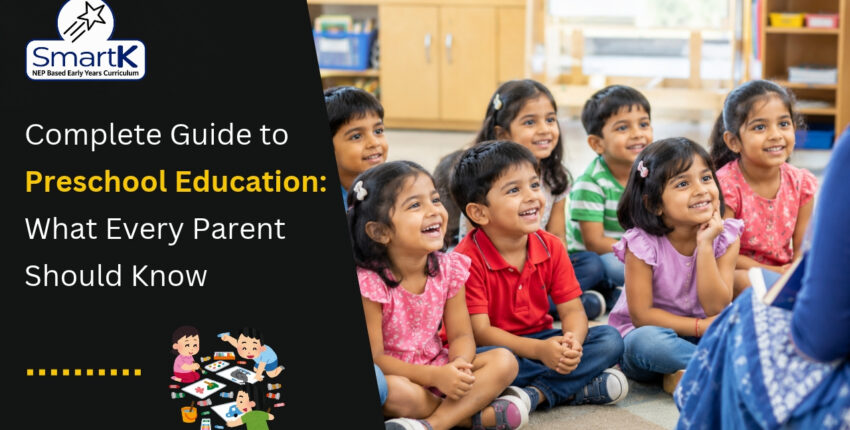
The preschool years are an important stage in a child’s development. Between the ages of 2 and 6, children develop rapidly in language, thinking, movement, social interaction, emotional understanding, and independence. Preschool education provides children with opportunities to develop these skills through age-appropriate activities before they enter primary school.
For parents, understanding preschool education can help them make informed decisions about their child’s early learning. A good preschool is not simply a place where children learn letters and numbers. It should provide a safe and engaging environment where children can play, explore, communicate, create, and gradually become independent learners.
What Is Preschool Education?
Preschool education refers to the early learning experience children receive before entering primary school. Depending on the school and programme, it may include stages such as Playgroup, Nursery, LKG, and UKG.
At this stage, children learn best through stories, conversations, games, movement, music, art, exploration, and hands-on experiences. Learning should be developmentally appropriate rather than based on excessive worksheets or academic pressure.
Parents should therefore look at how a preschool supports overall development rather than focusing only on how much academic content children are taught.
Why Is Preschool Education Important?
The early years provide an important foundation for future learning. Preschool gives children opportunities to develop communication, confidence, curiosity, coordination, social interaction, and early academic understanding.
Children learn how to listen, follow instructions, express their thoughts, cooperate with others, solve simple problems, and participate in group activities. These experiences can make the transition to primary school more comfortable.
A strong preschool curriculum should focus on building these foundational skills while allowing children to enjoy learning.
What Do Children Learn in Preschool?
A quality preschool programme supports different areas of child development. Language activities help children build vocabulary, listening skills, storytelling abilities, and confidence in communication. Early literacy experiences may introduce sounds, letters, rhymes, books, and pre-writing skills.
Children also develop early mathematical thinking through counting, sorting, patterns, shapes, comparisons, and simple problem-solving. These concepts can be introduced through games and everyday classroom experiences.
Physical development is equally important. Outdoor games, drawing, colouring, puzzles, clay work, and movement activities help children develop fine and gross motor skills.
Social and emotional learning helps children understand feelings, cooperate with others, take turns, develop friendships, and become more independent.
Parents can explore SmartK’s preschool curriculum ideas and examples to understand how different learning areas can be combined within early childhood education.
Why Is Play Important in Preschool?
Play is one of the most effective ways young children learn. Through play, children can explore ideas, communicate, solve problems, develop motor skills, and understand relationships.
For example, counting blocks can introduce early mathematics, while pretend play can develop language and social skills. Art and sensory activities can encourage creativity and exploration.
Therefore, an effective preschool education programme should combine purposeful learning with play and hands-on experiences.
The Role of Teachers and Parents
Teachers play an important role in creating a positive learning environment. They introduce appropriate age activities, observe children’s development, encourage participation, and provide support according to individual needs.
Parents also play an important role. Reading stories, singing rhymes, talking about daily experiences, counting objects, drawing, and involving children in simple household activities can reinforce learning at home.
Strong communication between teachers and parents helps create consistency between classroom and home learning.
How Should Parents Choose a Preschool?
Parents should look beyond the appearance of a school and consider its curriculum, teaching approach, teachers, classroom environment, safety, activities, and communication with families.
It is also useful to ask how the school observes children’s progress and supports different learning needs. A good preschool should provide a balance of structured learning, play, exploration, creativity, and social interaction.
SmartK’s preschool curriculum resources can also help schools and educators understand how structured early learning programmes can support children’s development.
Preparing Children for Primary School
The purpose of preschool is not to make children academically advanced before Grade 1. Instead, it should help them develop the foundational skills needed for future learning.
By the end of the preschool years, children should gradually become more confident communicators, independent learners, active participants, and capable problem-solvers. These foundations can support a smoother transition into primary education.
Frequently Asked Questions
- What is preschool education?
Preschool education is early learning provided before primary school. It supports children’s language, cognitive, physical, social, emotional, and creative development through age-appropriate experiences.
- What should children learn in preschool?
Children should develop early literacy, numeracy, communication, motor skills, creativity, social interaction, emotional awareness, independence, and problem-solving skills.
- Why is play important in preschool?
Play allows children to explore, communicate, solve problems, develop physical skills, and learn through real experiences. It makes learning engaging and meaningful.
- How can parents support preschool learning at home?
Parents can read stories, talk with children, sing rhymes, count everyday objects, encourage drawing, play educational games, and involve children in simple age-appropriate activities.
- How can parents choose the right preschool?
Parents should consider the preschool curriculum, teachers, learning approach, safety, classroom environment, activities, child development practices, and communication between the school and family.