

The LKG stage is an important transition in early childhood education. Children between 4 and 5 years are becoming more independent, developing stronger language abilities, and beginning to understand more structured concepts. A well-planned preschool curriculum for 4-5 year olds should support this development while ensuring that learning remains engaging, age-appropriate, and enjoyable.
For schools, an effective LKG curriculum should not focus only on academic preparation. It should help children develop communication, early literacy, numeracy, problem-solving, social skills, creativity, physical coordination, and confidence. The right balance between structured learning and play can create a strong foundation for the next stage of schooling.
What Should an LKG Curriculum for Schools Include?
A good LKG curriculum for schools should cover multiple areas of development rather than treating learning as a collection of separate subjects. Children should be encouraged to learn through conversations, stories, games, hands-on activities, classroom experiences, art, music, and exploration.
At this age, children can begin working with more structured learning tasks, but these should still be short, interactive, and appropriate for their developmental stage. Teachers should have clear learning objectives while retaining flexibility to adapt activities according to children’s interests and abilities.
Building Early Literacy and Language Skills
Language development becomes increasingly important during the LKG year. Children can be introduced to letter recognition, phonological awareness, vocabulary, storytelling, rhymes, and early writing skills through engaging activities.
Instead of relying heavily on worksheets, teachers can use picture books, story sequencing, sound games, role play, songs, and conversations. These experiences help children develop listening and speaking skills while gradually preparing them for reading and writing.
Developing Early Mathematical Thinking
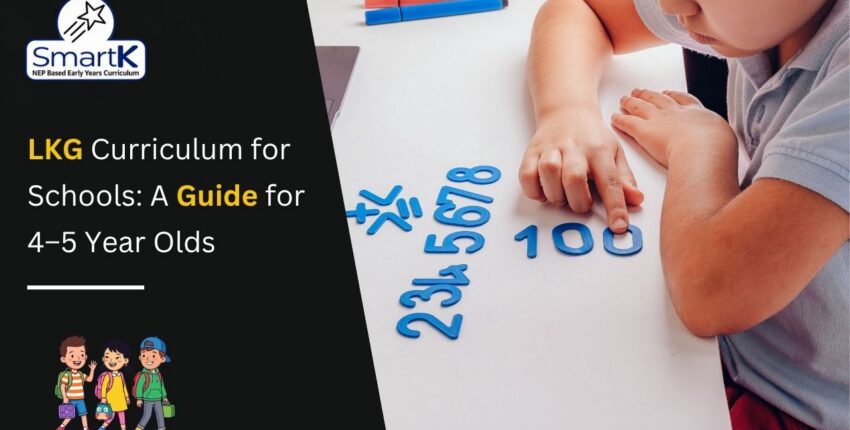
The LKG school curriculum should also introduce children to foundational mathematical concepts. Counting, number recognition, shapes, colours, patterns, comparisons, sorting, and simple quantities can be introduced through practical activities.
For example, children can count classroom objects, sort toys according to different characteristics, identify shapes in their surroundings, or create patterns using blocks. These activities allow children to understand mathematical ideas through direct experience rather than memorisation alone.
Encouraging Social and Emotional Development
An effective preschool curriculum for 4-5 year olds should give children opportunities to become more independent and socially confident. At this age, children are learning how to cooperate, follow classroom routines, express their feelings, solve simple disagreements, and work as part of a group.
Teachers can encourage these skills through group projects, cooperative games, storytelling, classroom responsibilities, and role-playing activities. Developing these abilities helps children become more confident learners and prepares them for the expectations of formal schooling.
Learning Through Creativity and Physical Activities
Art, music, movement, outdoor play, and hands-on activities are essential components of an effective LKG curriculum. Drawing, colouring, cutting, clay modelling, music, dance, puzzles, and construction activities can support creativity and fine motor development.
Outdoor games and movement activities help children develop balance, coordination, strength, and body awareness. These experiences also provide opportunities for children to practise cooperation and follow instructions in an enjoyable setting.
Supporting Teachers in LKG Classrooms
A successful LKG curriculum for schools should be practical for teachers to implement. Educators need clear learning objectives, age-appropriate activities, teaching resources, and opportunities to observe children’s progress.
Assessment at this stage should primarily focus on observation and developmental progress. Teachers can monitor children’s language, social interaction, early numeracy, motor skills, independence, and participation rather than relying exclusively on formal tests.
Schools can explore structured preschool curriculum solutions from SmartK to support activity-based and developmentally appropriate learning across different early years stages.
Creating a Strong Foundation for Future Learning
The purpose of an LKG programme is not simply to complete a list of academic topics. A strong LKG school curriculum should develop children’s curiosity, confidence, independence, communication, and willingness to learn.
When schools combine structured learning with play, creativity, movement, and real-world experiences, children can develop important foundational skills without unnecessary academic pressure. This creates a smoother transition into UKG and later primary education.
Frequently Asked Questions
- What is an LKG curriculum?
An LKG curriculum is a structured learning programme generally designed for children aged 4–5 years. It supports early literacy, numeracy, communication, social-emotional development, creativity, physical development, and independent learning.
- What should a preschool curriculum for 4-5 year olds include?
A preschool curriculum for 4-5 year olds should include language and early literacy, basic numeracy, creative activities, physical development, social-emotional learning, problem-solving, storytelling, and hands-on experiences.
- How can schools make an LKG curriculum engaging?
Schools can make learning engaging through stories, games, songs, role play, experiments, art, movement, puzzles, outdoor activities, and hands-on learning. Activities should be interactive and suited to children’s developmental levels.
- How should children be assessed in LKG?
LKG assessment should focus primarily on observation and developmental progress. Teachers can observe children’s communication, participation, early literacy and numeracy skills, social behaviour, motor development, and independence.
- What makes a good LKG curriculum for schools?
A good LKG curriculum for schools should be age-appropriate, child-centred, activity-based, flexible, and easy for teachers to implement. It should support holistic development rather than focusing only on academic outcomes.
- Why is play important in an LKG school curriculum?
Play helps children develop communication, creativity, problem-solving, motor coordination, social skills, and confidence. It also allows children to understand concepts through active participation and real experiences.