

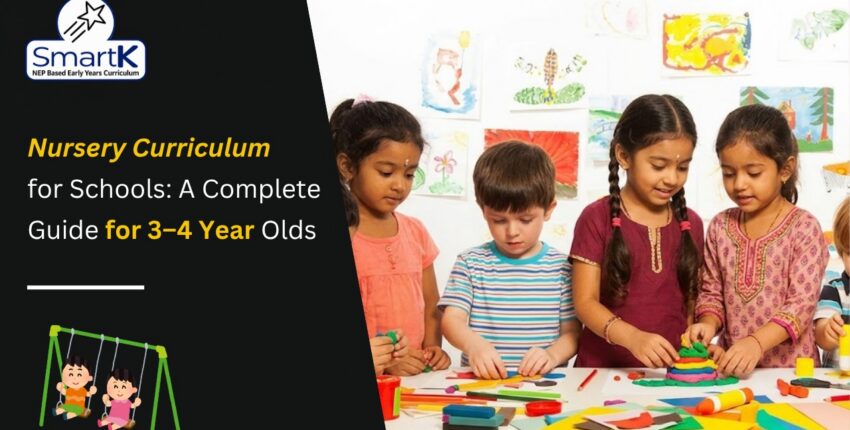
The nursery stage is an important period in early childhood education. Children between 3 and 4 years are becoming more independent, developing stronger communication skills, learning to interact with others, and beginning to understand basic concepts through everyday experiences. A well-planned preschool curriculum for 3-4 year olds should therefore focus on holistic development rather than academic learning alone.
For schools, choosing the right nursery curriculum means creating learning experiences that are age-appropriate, engaging, and connected to children’s natural curiosity. At this stage, children learn best through play, stories, conversations, movement, exploration, and hands-on activities.
What Should a Nursery Curriculum Include?
A strong nursery school curriculum should address different areas of development while maintaining a balance between structured learning and free exploration. Children should have opportunities to develop language, early mathematical thinking, motor skills, creativity, social awareness, and emotional confidence.
The curriculum should also allow teachers to observe children’s progress rather than expecting them to learn through formal tests or excessive worksheets. The focus should be on building foundational skills that prepare children for the next stage of education.
Language and Communication Development
Language development is a major part of learning at the nursery level. Children aged 3–4 are rapidly expanding their vocabulary and learning to express their thoughts, needs, and experiences.
A nursery curriculum for schools can include storytelling, rhymes, picture conversations, songs, role play, listening games, and simple discussions. Teachers can encourage children to describe objects, answer questions, narrate experiences, and participate in group conversations. These activities strengthen listening and speaking skills while gradually developing early literacy awareness.
Early Numeracy and Cognitive Skills
Nursery children do not need advanced mathematics. Instead, the curriculum should introduce foundational concepts through meaningful experiences. Counting objects, identifying colours and shapes, comparing sizes, sorting materials, recognising patterns, and understanding simple sequences can help develop early mathematical thinking.
For example, children can count toys during classroom activities, sort objects by colour, identify shapes around the classroom, or arrange objects from small to large. Such experiences make early numeracy practical and enjoyable.
Social and Emotional Learning
A high-quality preschool curriculum for 3-4 year olds should give equal importance to social and emotional development. Nursery children are learning how to share, take turns, follow routines, cooperate with classmates, and manage different emotions.
Teachers can support these skills through group activities, pretend play, stories about feelings, classroom responsibilities, and cooperative games. Children should gradually learn to express emotions, listen to others, solve simple conflicts, and become more comfortable participating in group settings.
Physical, Creative, and Experiential Learning
Physical development is another essential part of the nursery curriculum. Running, jumping, balancing, dancing, outdoor games, and movement activities help develop gross motor skills. Drawing, colouring, clay work, threading, puzzles, and simple craft activities support fine motor development.
Creative experiences also allow children to explore ideas without the pressure of producing a perfect result. Music, art, storytelling, dramatic play, and sensory activities can encourage imagination and self-expression.
Creating an Effective Nursery Curriculum for Schools
Schools should look for a curriculum that provides clear learning goals while giving teachers enough flexibility to respond to children’s interests and developmental needs. Daily routines should include a healthy mix of teacher-guided activities, independent exploration, group interaction, outdoor play, and quiet learning experiences.
Teacher support is equally important. A well-designed nursery school curriculum should make it easier for educators to understand learning objectives, plan activities, observe children, and communicate progress with parents.
SmartK provides structured early childhood curriculum solutions designed for preschool and foundational-stage learning. Schools can explore its preschool curriculum resources to understand how structured, activity-based learning can be incorporated into early years education.
Why the Right Nursery Curriculum Matters
The nursery year is not simply preparation for formal schooling. It is a stage where children develop the confidence, curiosity, communication abilities, social skills, and learning habits that support future education.
An effective nursery curriculum for schools should therefore be child-centred, developmentally appropriate, experiential, and flexible. When schools create the right balance between learning and play, children can build strong foundations while enjoying the process of discovering the world around them.
Frequently Asked Questions
- What is a nursery curriculum?
A nursery curriculum is a structured learning framework designed for children generally around 3–4 years old. It focuses on language, early numeracy, social-emotional development, physical skills, creativity, and learning through play and exploration.
- What should a preschool curriculum for 3-4 year olds include?
A preschool curriculum for 3-4 year olds should include age-appropriate language activities, early numeracy, storytelling, creative activities, physical development, social-emotional learning, sensory exploration, and opportunities for independent and group learning.
- How is a nursery curriculum different from a primary school curriculum?
A nursery curriculum focuses more on play, exploration, communication, movement, creativity, and foundational concepts. Unlike primary education, it should not depend heavily on formal examinations, lengthy written work, or academic pressure.
- Why is play important in a nursery school curriculum?
Play allows children to explore ideas, practise communication, develop social skills, solve simple problems, and build physical coordination. It makes learning meaningful while supporting multiple areas of child development at the same time.
- How can schools choose the right nursery curriculum?
Schools should consider whether the curriculum is developmentally appropriate, child-centred, activity-based, easy for teachers to implement, and supported by suitable learning resources and assessment methods. It should also provide flexibility for different learning needs.
- What skills should children develop during nursery?
Children should gradually develop communication, listening, early literacy and numeracy awareness, motor coordination, creativity, independence, social interaction, emotional expression, and problem-solving skills during the nursery stage.