

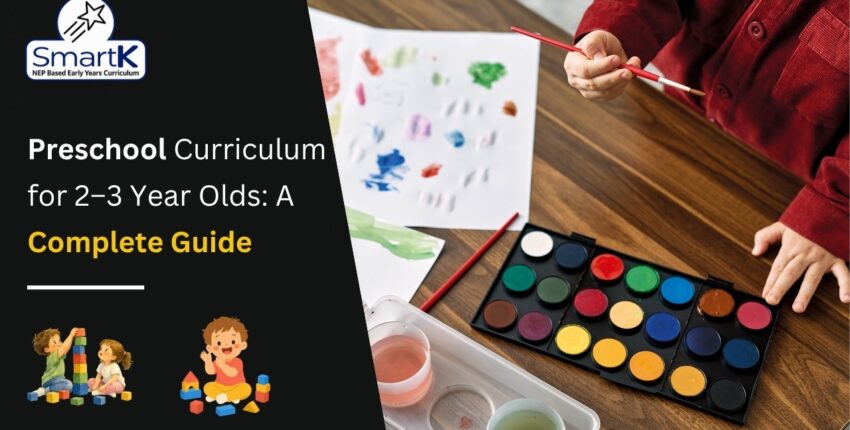
The age of 2–3 years is a significant stage in a child’s early development. During these years, children become increasingly curious, independent, communicative, and eager to explore the world around them. This makes it important for schools to provide a learning environment that supports development without placing unnecessary academic pressure on young children. A well-designed preschool curriculum for 2–3 year olds should focus on learning through play, exploration, interaction, movement, and everyday experiences.
Unlike a curriculum designed for older children, a toddler curriculum should not be centred around memorisation or formal academic instruction. Children at this age learn most effectively when they can touch, observe, listen, move, experiment, and communicate. The role of the teacher is to create meaningful experiences that encourage curiosity while supporting the child’s individual pace of development.
What Should a Curriculum for 2–3 Year Olds Include?
A good curriculum for toddlers should address the different areas of early childhood development together. Language, cognitive skills, physical development, social interaction, emotional development, creativity, and independence are all connected at this stage.
For example, a simple storytelling activity can introduce new vocabulary while also encouraging listening, imagination, emotional understanding, and communication. Similarly, a building activity can develop fine motor coordination while encouraging children to experiment with shapes, sizes, balance, and problem-solving.
This is why an effective toddler preschool curriculum should provide a variety of experiences rather than relying on a single teaching method.
Language and Communication Development
Children between two and three years experience rapid language development. They begin learning new words, forming short sentences, asking questions, and expressing their needs more clearly. Preschool provides an important opportunity to strengthen these emerging communication skills.
Teachers can use conversations, songs, rhymes, picture books, storytelling, and pretend play to encourage children to listen and communicate. Instead of expecting children to memorise words, educators can introduce vocabulary naturally through everyday classroom experiences.
Regular storytelling is particularly valuable because it exposes children to new words and sentence structures while encouraging them to listen and respond. Asking simple questions about a story can also help children express their thoughts and develop confidence.
Learning Through Play and Exploration
Play should be at the heart of a preschool curriculum for 2–3 year olds. Young children naturally learn by exploring their surroundings and experimenting with objects. A classroom that allows children to investigate and make discoveries can support learning across several developmental areas at the same time.
Blocks, puzzles, sorting games, sensory activities, pretend play, and creative materials can introduce early concepts without making learning feel like formal study. When children build a tower, for example, they are not simply playing. They are developing coordination, spatial awareness, problem-solving abilities, and creativity.
A play-based approach also gives teachers opportunities to observe how individual children think, communicate, interact, and respond to challenges.
Supporting Social and Emotional Development
Social and emotional development is another essential part of a toddler curriculum. Children at this age are beginning to understand relationships, emotions, sharing, and classroom routines. They need opportunities to interact with other children and learn how to communicate their feelings appropriately.
Teachers can support this development through group activities, storytelling, role-play, music, and everyday classroom conversations. Simple situations such as sharing toys or waiting for a turn can become valuable learning experiences.
A supportive teacher-child relationship is equally important. When children feel safe and respected, they are more likely to participate, communicate, and explore confidently.
Developing Physical and Motor Skills
Physical development should also be integrated into the toddler preschool curriculum. Children need opportunities to develop both fine and gross motor skills through everyday activities.
Drawing, painting, clay play, building, and simple craft activities help children develop hand control and coordination. Outdoor play, dancing, running, jumping, and movement games support balance, coordination, and physical confidence.
These activities should be enjoyable rather than performance-focused. The objective is to give children regular opportunities to move, explore, and gradually develop control over their bodies.
Effective Preschool Activities for 2 Year Olds
The best preschool activities for 2 year olds are simple, interactive, and connected to children’s natural interests. Sensory play, music and movement, picture storytelling, colour exploration, nature walks, pretend play, and creative activities can all become valuable learning experiences.
Teachers can also connect activities to everyday themes such as animals, family, food, seasons, transport, and nature. Familiar subjects make it easier for young children to understand new concepts and connect classroom learning with their experiences outside school.
The emphasis should always be on participation and exploration rather than producing a perfect result.
Creating an Age-Appropriate Learning Environment
A successful preschool curriculum for 2–3 year olds depends not only on what children learn but also on how the learning environment is designed. Classrooms should provide safe spaces where children can move, explore, interact, and access age-appropriate learning materials.
Teachers should also maintain flexible routines. Toddlers have different attention spans and developmental needs, so activities may need to be adjusted according to the children’s energy, interests, and responses.
Modern curriculum providers such as SmartK focus on structured yet engaging approaches that help schools create meaningful early-learning experiences.
Frequently Asked Questions
What should a preschool curriculum for 2–3 year olds include?
A preschool curriculum for 2–3 year olds should focus on language development, social and emotional skills, cognitive development, physical and motor skills, creativity, communication, and independence. Learning should primarily take place through play and hands-on experiences.
What is the best curriculum for toddlers?
The best curriculum for toddlers is age-appropriate, flexible, and play-based. It should give children opportunities to explore, communicate, move, create, and interact rather than focusing heavily on formal academics or memorisation.
What are some good preschool activities for 2 year olds?
Preschool activities for 2 year olds can include storytelling, sensory play, music and movement, drawing, painting, building blocks, simple puzzles, nature exploration, pretend play, and colour or shape activities.
How long should a preschool activity last for a 2-year-old?
Activities for toddlers should generally be short and flexible because young children have developing attention spans. Teachers should observe children’s engagement and adapt the duration rather than following a rigid schedule.
Why is play important in a toddler preschool curriculum?
Play allows children to learn naturally through exploration and experimentation. It can simultaneously support language, problem-solving, creativity, physical coordination, social skills, and emotional development.
How can schools choose the right toddler curriculum?
Schools should look for a toddler preschool curriculum that is developmentally appropriate, activity-based, flexible, and supported by practical teaching resources. The curriculum should help teachers address multiple areas of child development while keeping learning engaging and age-appropriate.
Conclusion
A strong preschool curriculum for 2–3 year olds is not about teaching children as much as possible at the earliest age. It is about creating the right experiences for children to develop naturally. Through play, storytelling, movement, creative exploration, communication, and social interaction, toddlers can build the foundations they need for future learning.
For schools, the right toddler curriculum should therefore be developmentally appropriate, flexible, engaging, and centred on the whole child. When young children enjoy learning and feel confident exploring their environment, preschool becomes the foundation for a positive and lifelong relationship with education.