

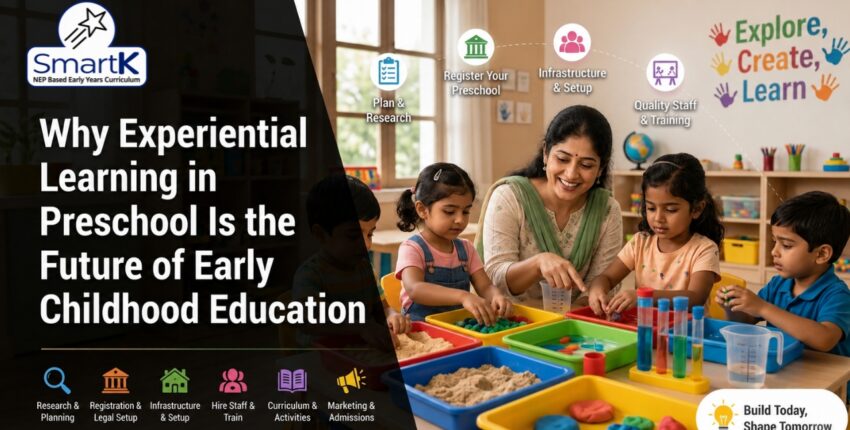
The way children learn is changing rapidly, especially in early childhood education. Traditional teaching methods based mainly on memorization and repetition are gradually being replaced by more engaging and interactive approaches. One of the most effective and widely adopted modern teaching methods is experiential learning in preschool.
Experiential learning focuses on “learning by doing.” Instead of simply listening to instructions or memorizing information, children actively participate in activities, experiments, storytelling, role-play, games, and other hands-on learning experiences. This approach helps children understand concepts better while improving creativity, communication, problem-solving, and social skills.
Today, parents, educators, and schools increasingly prefer experiential learning models because they create stronger engagement and better developmental outcomes for young learners.
What Is Experiential Learning in Preschool?
Experiential learning in preschool is a child-centric teaching method in which children learn through direct experience and active participation. Instead of passive classroom instruction, children are encouraged to explore, observe, ask questions, and interact with their environment.
Experiential learning activities may include:
– Storytelling and role-play
– Art and craft activities
– Sensory play
– Nature-based learning
– Music and movement sessions
– STEM-based activities
– Group discussions and teamwork
This method supports holistic child development by combining cognitive, emotional, social, and physical learning experiences.
Schools implementing:
– An activity-based preschool curriculum
– Interactive classroom methodologies
– Holistic learning frameworks
are increasingly seeing better classroom participation and stronger learning outcomes.
Why Traditional Learning Methods Are Changing
For many years, preschool education focused heavily on worksheets, memorization, and repetitive teaching patterns. However, research in child psychology and neuroscience shows that young children learn more effectively through active exploration and play-based learning.
Children naturally learn by:
– Observing their surroundings
– Asking questions
– Experimenting with objects
– Engaging in conversations
– Participating in activities
Experiential learning allows children to develop curiosity and independent thinking instead of simply memorizing information.
This shift aligns closely with modern educational approaches promoted under the NEP-aligned preschool education framework, which encourages activity-based and experiential learning systems.
Benefits of Experiential Learning in Preschool
- Improves Concept Understanding
Children understand concepts better when they experience them directly. For example, learning about plants through gardening activities is more effective than only reading about plants in a book.
Hands-on activities help children retain information longer and apply their knowledge more confidently.
- Encourages Creativity and Innovation
Experiential learning encourages children to think independently and explore multiple solutions to a problem. Activities such as storytelling, drawing, building blocks, and pretend play stimulate imagination and creativity.
Creative thinking developed at an early stage supports future problem-solving and decision-making abilities.
- Builds Communication and Social Skills
Interactive classroom activities encourage children to communicate, collaborate, and share ideas with others. Group-based learning experiences help improve:
– Listening skills
– Verbal communication
– Teamwork
– Emotional understanding
These social interactions are essential for building confidence and encouraging classroom participation.
- Enhances Emotional Development
Experiential learning environments are usually more engaging and less stressful than rigid academic settings. Children feel comfortable expressing emotions, participating freely, and learning at their own pace.
This approach supports:
– Emotional intelligence
– Self-confidence
– Positive behaviour
– Adaptability
all of which are equally important for long-term success.
- Makes Learning Enjoyable
Children naturally enjoy movement, play, creativity, and exploration. Experiential learning transforms classrooms into exciting environments where education becomes enjoyable rather than stressful.
Happy learners are often more motivated, curious, and engaged during classroom activities.
Role of Teachers in Experiential Learning
Teachers play the role of facilitators rather than traditional instructors. Instead of simply delivering information, educators guide children through activities, discussions, and exploratory learning experiences.
Modern preschool educators increasingly require:
– Activity-based teaching methods
– An understanding of child psychology
– Creative classroom management skills
– Interactive learning resources
Schools adopting modern preschool curriculum solutions often provide teachers with structured learning frameworks and innovative classroom tools.
How Parents Benefit from Experiential Learning Models
Parents today seek educational systems that support complete child development rather than academic performance alone. Experiential learning helps children become:
– More confident
– Better communicators
– Independent thinkers
– Emotionally balanced learners
This builds stronger parent satisfaction and trust in schools that adopt modern educational practices.
The growing popularity of experiential learning in preschool reflects a major shift in early childhood education. By focusing on hands-on activities, creativity, exploration, and interaction, experiential learning helps children develop essential life skills while making education enjoyable and meaningful.
As preschool education continues to evolve, schools that adopt experiential and activity-based learning methods will be better equipped to support holistic child development and future-ready learning experiences.