

Children with strong social and emotional skills are able to:
- Increase self-confidence
- Improve communication abilities
- Adapt more easily to school environments
Children with strong emotional skills are often more engaged learners and better problem-solvers later in life.
- Helps Children Understand and Manage Emotions
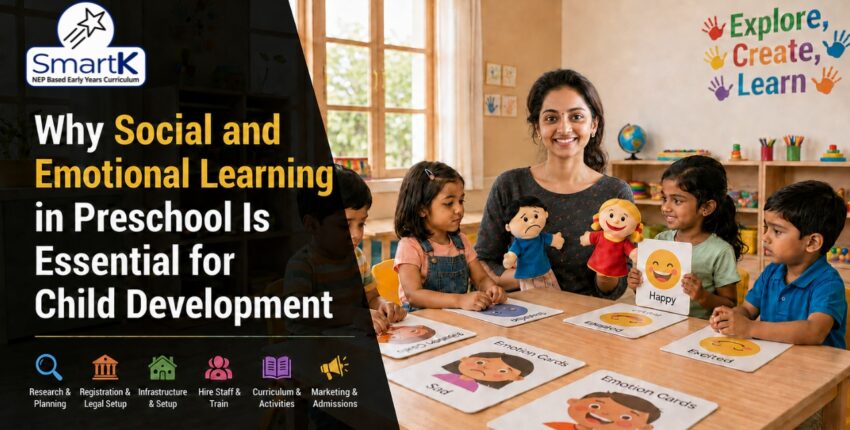
Young children experience many emotions but may not always know how to express them properly. SEL activities help children identify feelings such as happiness, sadness, frustration, excitement, and fear.
Teachers use:
- Storytelling sessions
- Role-play activities
- Emotion cards
- Interactive discussions
to help children understand emotions and respond positively to situations.
This emotional awareness improves self-control and reduces behavioural challenges in classrooms.
- Improves Communication and Social Skills
One of the biggest benefits of social and emotional learning in preschool is improved communication. Children learn how to:
- Listen actively
- Share ideas
- Work in teams
- Respect others
- Express feelings confidently
Interactive group activities encourage cooperation and healthy classroom participation.
Preschool programs that use interactive preschool learning methods often create more engaging and socially active classroom environments.
- Builds Self-Confidence and Independence
SEL encourages children to make decisions, solve small problems independently, and express themselves openly. As children participate in discussions and activities, they gradually build confidence in their abilities.
Confident children are usually more willing to:
- Participate in classroom activities
- Ask questions
- Explore new ideas
- Build friendships
- Adapt to new environments
These skills support both academic and personal growth.
- Encourages Empathy and Positive Behaviour
Empathy is one of the most important life skills children can develop. SEL teaches children how to understand the feelings and perspectives of others.
Activities such as:
- Cooperative games
- Group storytelling
- Sharing exercises
- Classroom teamwork
help children practice kindness, patience, and respect in daily interactions.
This creates more positive classroom behaviour and stronger peer relationships.
- Supports Better Academic Readiness
Children who feel emotionally secure often perform better academically because they are more focused, cooperative, and motivated to learn.
SEL supports:
- Classroom engagement
- Attention span
- Listening skills
- Problem-solving abilities
- Decision-making skills
all of which are essential for future learning success.
Modern curriculum providers increasingly integrate SEL into NEP-aligned preschool curricula to support complete child development.
Role of Teachers and Parents in SEL Development
Both teachers and parents play important roles in helping children develop emotional intelligence and social confidence.
Parents can support SEL by:
- Encouraging open communication
- Discussing emotions regularly
- Teaching kindness and sharing
- Reading emotional development stories
- Practicing positive reinforcement
Teachers can further strengthen SEL through supportive classroom interactions and collaborative learning experiences.
Conclusion
The importance of social and emotional learning in preschool continues to grow as modern education moves toward holistic child development. Emotional intelligence, communication, empathy, confidence, and relationship-building are essential life skills that begin developing during early childhood.
Preschools that integrate SEL into daily learning experiences help children become emotionally balanced, socially confident, and academically prepared learners. By combining activity-based learning with emotional development strategies, schools can create healthier and more engaging educational environments for young children.