

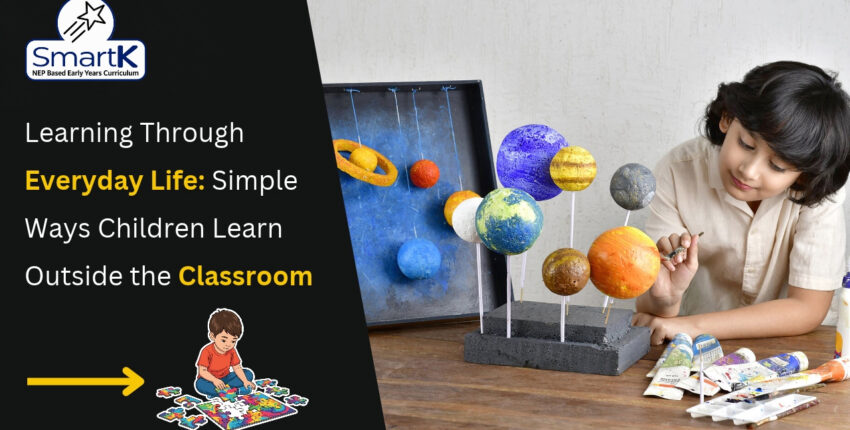
Learning does not happen only inside a preschool classroom. Young children learn continuously through conversations, play, observation, movement, household activities, and interactions with the people around them. Everyday experiences can help children develop language, early mathematical thinking, problem-solving, independence, and social skills.
For parents, this means that meaningful learning does not always require worksheets or special educational materials. Ordinary activities can become valuable learning opportunities when children are encouraged to participate, observe, ask questions, and think.
Learning Through Conversations
Everyday conversations are an important part of early learning. Talking about meals, weather, family activities, objects, and experiences helps children develop vocabulary and communication skills.
Parents can ask children to describe what they see, explain what they are doing, or tell a story about something that happened during the day. These simple conversations encourage children to express ideas and listen to others.
Mathematics in Everyday Activities
Children can discover early mathematical concepts through daily routines. Counting fruits while shopping, comparing the sizes of objects, sorting clothes, measuring ingredients, or identifying shapes around the home can introduce mathematical thinking naturally.
These experiences help children understand that mathematics is connected to the world around them rather than being limited to classroom exercises.
Learning Through Cooking
Cooking provides opportunities to develop several skills at once. Children can help wash vegetables, identify ingredients, count items, compare quantities, observe changes, and follow simple sequences.
Parents can introduce words such as “more,” “less,” “first,” “next,” “before,” and “after.” Children also develop practical skills and confidence when they participate in age-appropriate household tasks.
Exploring Nature
Outdoor experiences can encourage observation and curiosity. A walk in a park or garden can become an opportunity to notice leaves, flowers, insects, weather, colours, sounds, and textures.
Parents can ask questions such as “What do you notice?” or “Why do you think the leaves are moving?” This encourages children to observe carefully and develop early scientific thinking.
Learning Through Stories and Books
Books can be part of everyday learning at home. Parents can read stories and encourage children to predict what might happen next, describe characters, identify emotions, and retell the story.
Reading together also supports vocabulary, listening, imagination, and communication. These skills are important foundations for later literacy.
Household Activities Build Independence
Simple responsibilities can support learning and independence. Children can help organise toys, put away books, sort laundry, arrange objects, or prepare simple items with adult supervision.
These activities can teach children to follow instructions, complete sequences, make decisions, and take responsibility for their surroundings.
Play and Real-World Learning
Play connects everyday experiences with imagination and problem-solving. Children may turn a cardboard box into a shop, use toys to recreate a family experience, or build structures with blocks.
Such activities support creativity, communication, cooperation, and reasoning. SmartK’s experiential learning approach explains how children can learn effectively through meaningful experiences.
Creating a Learning-Rich Home
Parents do not need to create a formal classroom at home. A learning-rich environment can simply provide access to books, drawing materials, puzzles, building blocks, age-appropriate games, and opportunities for conversation and exploration.
The most important factor is adult involvement. When parents show interest in children’s questions and encourage them to explore, everyday experiences can become powerful learning opportunities.
Frequently Asked Questions
- Can children really learn through everyday activities?
Yes. Everyday activities provide opportunities to develop language, mathematical thinking, problem-solving, observation, independence, and social skills.
- How can parents make daily educational?
Parents can involve children in cooking, shopping, sorting, cleaning, outdoor walks, conversations, and simple household tasks while encouraging them to observe and ask questions.
- How does outdoor play support learning?
Outdoor experiences encourage children to observe nature, develop physical skills, explore their surroundings, and ask questions about the world around them.
- Is play considered learning?
Yes. Play can support cognitive, language, physical, social, and creative development. Children often learn important concepts while experimenting and interacting during play.
- Do parents need special educational materials?
Not necessarily. Everyday objects, books, household materials, toys, and outdoor environments can provide many learning opportunities when used thoughtfully.
- How can schools and parents support the same learning goals?
Regular communication can help parents understand what children are learning at school and provide related experiences at home. This creates greater consistency between classroom and home learning.