

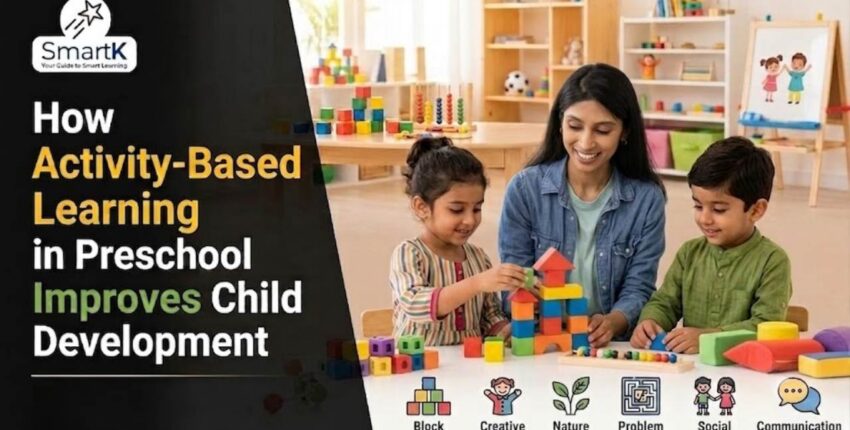
Modern preschool education is moving beyond traditional rote learning methods and focusing more on interactive, child-centric teaching approaches. One of the most effective methods gaining popularity among educators and schools is activity-based learning in preschool. This approach encourages children to learn through hands-on experiences, play, creativity, exploration, and participation rather than passive memorization.
Young children naturally learn best when they are actively involved in the learning process. Activity-based learning creates engaging classroom environments where children can develop cognitive, emotional, social, physical, and communication skills in a fun and meaningful way.
Today, many schools and curriculum providers are adopting activity-based learning frameworks to improve classroom engagement, holistic child development, and long-term learning outcomes.
What Is Activity-Based Learning in Preschool?
Activity-based learning in preschool is a teaching method where children learn through activities, games, experiments, storytelling, creative projects, and interactive experiences. Instead of focusing only on textbooks or worksheets, children actively participate in tasks that help them understand concepts naturally.
Examples of activity-based preschool learning include:
- Role-play and storytelling
- Art and craft projects
- Building and construction games
- Music and movement activities
- Sensory play
- Group learning activities
- Nature exploration
- Puzzle-solving and creative tasks
Schools implementing:
- Activity-Based Preschool Curriculum
- Experiential learning methods
- Child-centric educational frameworks
often create more engaging and effective learning environments.
Why Activity-Based Learning Is Important
Children in preschool years have shorter attention spans and high levels of curiosity. Traditional instruction-heavy classrooms may not fully support their natural learning behaviour. Activity-based learning keeps children involved and motivated while improving understanding and retention.
This learning approach helps children:
- Learn through direct experiences
- Develop creativity and imagination
- Improve concentration and participation
- Build communication and teamwork skills
- Strengthen confidence and independence
Modern educational systems, including:
- NEP Aligned Preschool Education
strongly encourage activity-based learning for holistic child development.
- Improves Cognitive Development
One of the biggest benefits of activity-based learning in preschool is stronger cognitive development. Activities encourage children to think, observe, analyze, and solve problems independently.
Interactive learning experiences help children:
- Understand concepts more clearly
- Improve memory retention
- Develop logical thinking
- Build decision-making skills
For example, sorting games help children recognize patterns and categories, while building activities encourage problem-solving and spatial understanding.
- Encourages Creativity and Imagination
Creative activities such as storytelling, drawing, pretend play, and craft projects stimulate imagination and innovative thinking. Children learn to express ideas freely and explore multiple possibilities during activities.
Creative classrooms encourage:
- Independent thinking
- Artistic expression
- Curiosity and exploration
- Innovation and experimentation
These skills are essential for future learning and adaptability.
- Strengthens Communication and Social Skills
Group-based activities allow children to interact, communicate, share, and collaborate with classmates. This improves:
- Listening skills
- Verbal communication
- Teamwork
- Emotional understanding
- Social confidence
Children gradually become more comfortable participating in discussions and classroom interactions.
Schools using:
- Interactive Preschool Learning Programs
often see improved classroom participation and student engagement.
- Supports Physical and Motor Skill Development
Many preschool activities involve movement, coordination, and hands-on participation. Activities such as colouring, clay modelling, dancing, and outdoor games help improve:
- Fine motor skills
- Hand-eye coordination
- Physical balance
- Muscle development
These activities also support healthy physical growth and classroom readiness.
- Makes Learning Enjoyable and Stress-Free
Children naturally enjoy learning through play and exploration. Activity-based learning reduces academic pressure while making education fun and interactive.
When children enjoy classroom activities, they become:
- More motivated learners
- More confident participants
- Better problem-solvers
- Emotionally comfortable in school environments
Positive early learning experiences often create lifelong interest in education.
Role of Teachers in Activity-Based Learning
Teachers act as facilitators who guide children through experiences instead of only delivering information. Educators encourage exploration, discussion, and participation while supporting individual learning styles.
Modern preschool teachers increasingly require:
- Creative classroom planning skills
- Child psychology understanding
- Interactive teaching methodologies
- Experiential learning strategies
Schools implementing:
- Modern Preschool Curriculum Solutions
often provide structured activity-based resources and teacher support systems.
How Parents Benefit from Activity-Based Education
Parents today prefer educational systems that focus on complete child development instead of only academic performance. Activity-based learning helps children become:
- Independent thinkers
- Better communicators
- More creative learners
- Emotionally balanced
- Socially confident
This improves both learning outcomes and parent satisfaction.
Conclusion
The growing popularity of activity-based learning in preschool reflects the changing future of early childhood education. By combining creativity, participation, exploration, and hands-on experiences, activity-based learning helps children develop essential academic and life skills naturally.
Preschools adopting activity-based educational models create more engaging, child-friendly, and development-focused learning environments that prepare children for future success while making learning enjoyable and meaningful.