

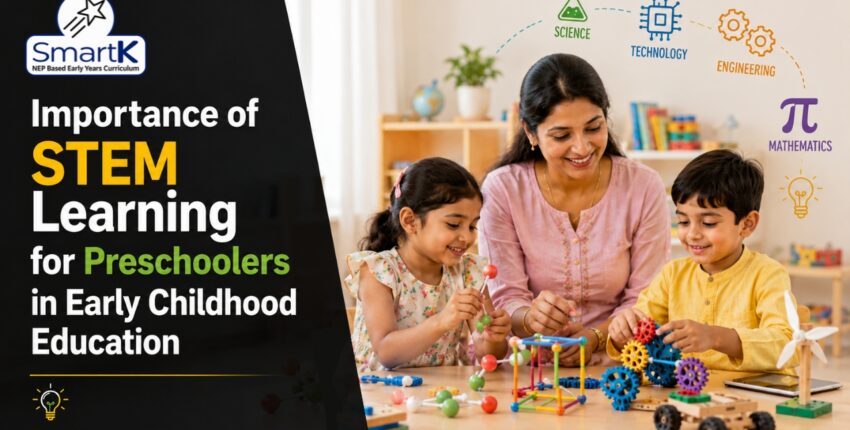
The future of education is rapidly evolving, and schools are increasingly focusing on skills that prepare children for innovation, creativity, and problem-solving. One of the fastest-growing educational approaches today is STEM learning for preschoolers. STEM stands for Science, Technology, Engineering, and Mathematics, and introducing these concepts during early childhood helps children develop curiosity, logical thinking, and analytical abilities from a young age.
Contrary to common belief, STEM education for preschoolers is not about complicated science lessons or advanced mathematics. Instead, it focuses on hands-on exploration, observation, experimentation, creativity, and problem-solving through age-appropriate activities and play-based learning experiences.
Modern preschool education systems are increasingly integrating STEM-based activities into classroom learning to encourage innovation and future-ready skills among young learners.
What Is STEM Learning for Preschoolers?
STEM learning for preschoolers introduces basic scientific and mathematical concepts through fun, interactive, and activity-based learning methods. Preschool children naturally explore their surroundings through observation, experimentation, and questioning, making early childhood the ideal stage for STEM-based education.
STEM activities for preschoolers may include:
- Building blocks and construction games
- Water and sand play experiments
- Shape and pattern recognition
- Counting and sorting activities
- Nature exploration
- Simple problem-solving tasks
- Creative engineering activities
Schools using an activity-based preschool curriculum, interactive learning frameworks, and experiential classroom activities can integrate STEM concepts naturally into daily learning experiences.
Why STEM Education Is Important in Preschool
Children are naturally curious learners. They ask questions, explore objects, and try to understand how things work. STEM education encourages this curiosity while helping children develop foundational thinking skills.
Introducing STEM at an early stage helps children:
- Develop critical thinking abilities
- Improve creativity and innovation
- Strengthen logical reasoning
- Build confidence in problem-solving
- Enhance observation skills
- Encourage independent learning
These abilities continue to benefit children throughout their academic journey and future careers.
- Encourages Curiosity and Exploration
One of the biggest benefits of STEM learning for preschoolers is that it encourages children to ask questions and explore their environment actively.
Simple activities such as:
- Mixing colours
- Observing plants grow
- Building structures with blocks
- Exploring floating and sinking objects
help children learn through direct experience instead of passive instruction.
Experiential learning environments encourage children to become active participants in the learning process.
- Develops Problem-Solving Skills
STEM activities challenge children to think, experiment, and discover solutions independently. For example, building towers with blocks teaches balance, structure, and problem-solving through trial and error.
Children gradually learn how to:
- Analyze situations
- Test ideas
- Make decisions
- Improve solutions creatively
These problem-solving abilities become essential life skills later in education and career development.
- Improves Creativity and Innovation
STEM learning is not limited to science and mathematics alone. It also supports creativity and imagination by encouraging children to design, build, experiment, and explore ideas freely.
Activities such as:
- Creative construction
- Art-based STEM projects
- Story-based science activities
- Interactive group challenges
help children think innovatively while enjoying the learning process.
Modern preschool systems using experiential learning programs often create more engaging and creativity-focused classrooms.
- Builds Confidence Through Hands-On Learning
Children gain confidence when they successfully complete activities and solve simple challenges independently. STEM-based learning encourages active participation instead of passive memorization.
Hands-on activities help children:
- Feel more involved in learning
- Participate confidently
- Explore without fear of failure
- Develop independent thinking
This positive learning environment improves both classroom engagement and emotional development.
- Supports Future-Ready Skills
The modern world increasingly values innovation, adaptability, analytical thinking, and creativity. Introducing STEM learning early helps children develop these future-ready skills naturally.
Even basic preschool STEM activities contribute to:
- Technological understanding
- Logical thinking
- Decision-making abilities
- Team collaboration
- Communication skills
These skills align closely with modern educational frameworks and evolving career demands.
Role of Teachers in STEM-Based Preschool Education
Teachers play an important role in making STEM learning engaging and age-appropriate for preschoolers. Instead of traditional instruction methods, educators guide children through exploration, questioning, and hands-on activities.
Modern preschool educators increasingly require:
- Activity-based teaching methods
- Creative classroom planning
- Interactive learning tools
- Child-centric educational resources
Schools implementing modern preschool curriculum solutions often provide structured STEM learning support and innovative classroom methodologies.
How Parents Can Encourage STEM Learning at Home
Parents can support STEM learning through simple daily activities such as:
- Counting objects during play
- Encouraging curiosity and questions
- Exploring nature together
- Playing construction and puzzle games
- Conducting safe home experiments
The goal is to make learning interactive, enjoyable, and discovery-oriented.
Conclusion
The growing importance of STEM learning for preschoolers reflects the changing future of education and child development. STEM-based preschool education encourages curiosity, creativity, critical thinking, and problem-solving through engaging hands-on learning experiences.
By integrating STEM concepts into early childhood education, schools can create innovative and future-ready learning environments that prepare children not only for academic success but also for lifelong learning and adaptability.