

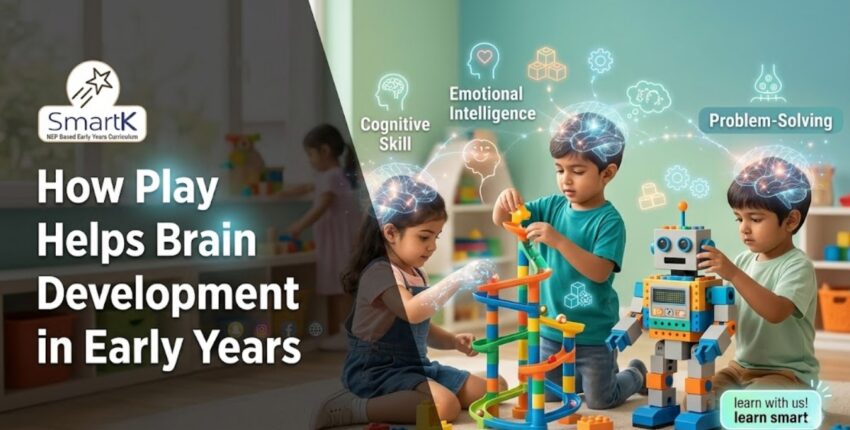
How Play Helps Brain Development in Early Years
Play may look like simple fun, but in early childhood it is one of the most powerful ways children learn and grow. During the first five years of life, a child’s brain develops at an extraordinary speed, forming the foundation for language, memory, emotional regulation, movement, and problem-solving.
Play supports this growth naturally by giving children hands-on, meaningful experiences that strengthen brain connections.
For parents and educators, understanding how play supports brain development can completely transform the way early learning is viewed. Young children don’t learn best through formal lessons alone — they learn deeply through exploration, imagination, movement, and interaction.
Why Early Years Matter for Brain Development
From birth to around age five, the brain forms millions of neural connections. These connections grow stronger when children engage with people, objects, sounds, language, and environments. Repeated positive experiences help build healthy pathways used for future learning.
Play provides exactly these kinds of experiences in an enjoyable and age-appropriate way.
- Play Builds Language Skills
When children play, they talk, listen, imitate sounds, and learn new words. Whether they are pretending to run a shop, singing rhymes, or describing something they built, they are constantly expanding vocabulary and communication skills.
Playful conversations also teach:
- Turn-taking
- Listening skills
- Expressing ideas and emotions
These early communication skills form the foundation for reading and writing later on.
- Play Strengthens Memory and Attention
Simple games like matching cards, puzzles, or remembering rules help children practice working memory and focus. These abilities are essential for classroom learning and everyday tasks.
Even small activities — like following a treasure hunt clue or remembering where a toy was placed — exercise the brain and build attention span.
- Play Encourages Problem-Solving
Play naturally presents children with small challenges:
- How do I stack blocks higher?
- How can I fit this shape?
- What happens if I mix these colors?
By experimenting, failing, and trying again, children develop reasoning skills, flexibility, and confidence in solving problems independently.
- Play Supports Social and Emotional Growth
Group play teaches children essential life skills such as:
- Sharing
- Cooperation
- Patience
- Empathy
Pretend play allows children to explore emotions and social roles by acting out real-life situations like caring for a doll or helping a friend.
These experiences help children build emotional awareness and self-control.
- Imaginative Play Boosts Creativity
When a child turns a cardboard box into a car or pretends a spoon is a microphone, they are using symbolic thinking. This ability is strongly linked to creativity, flexible thinking, and later academic skills such as reading comprehension and writing.
Imagination teaches children that one object or idea can represent another — a powerful foundation for learning.
Best Types of Play for Early Brain Development
Children benefit from many forms of play, including:
- Free play
- Outdoor play
- Pretend play
- Music and movement
- Building blocks and puzzles
- Art and sensory play
- Storytelling and role play
The most effective play is often simple, child-led, and supported by responsive adults.
Final Thoughts
Play is not separate from learning in the early years. It is one of the brain’s most effective learning tools. Through play, children build language, memory, emotional skills, creativity, and physical coordination. Giving children time, space, and encouragement to play is one of the best ways to support healthy brain development in the early years.