
Introduction
In India, early childhood education is often misunderstood due to overlapping terms like preschool, kindergarten, and primary school. Many parents assume these stages are similar, but each phase serves a distinct developmental purpose in a child’s learning journey.
With the introduction of the National Education Policy (NEP 2020), early education has been clearly restructured under the Foundational Stage, making it even more important for parents and schools to understand the role of each level.
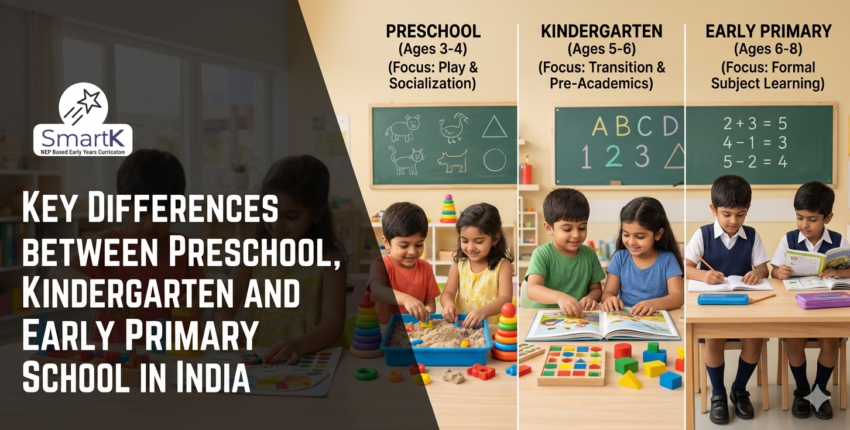
This blog explains the key differences between preschool, kindergarten, and early primary school in India, covering age groups, learning objectives, teaching methods, and outcomes.
- Preschool – The Foundation of Learning
Preschool is a child’s first step into the world outside home. This stage is not about textbooks or exams – it’s more about development.
Age Group:
2 to 4 years
Learning Focus:
Preschool focuses on sensory development, social skills, and basic language exposure. At this stage, children learn through exploration rather than instruction.
Learning happens through:
- Play-based activities
- Storytelling, music, and movement
- Sensory play and hands-on experiences
- Free expression and imagination
There is no pressure to read or write. Instead, children develop skills like listening, communicating, sharing, and expressing emotions.
Teaching Approach:
- Play-based and activity-based learning
- Storytelling, music, art, and movement
- Sensory activities and free play
- Language exposure without formal reading or writing
Key Outcomes:
- Improved communication and listening skills
- Emotional and social readiness
- Motor skill development
- Comfort with structured environments
Preschool is not about academics. Its primary goal is to help children feel safe, curious, and confident in a school setting.
- Kindergarten – School Readiness Stage
Kindergarten—typically divided into LKG and UKG—acts as a bridge between play-based learning and formal education.
Age Group:
4 to 6 years
Learning Focus:
Kindergarten prepares children for primary school by introducing early literacy, numeracy, and structured routines, while still maintaining a play-based approach.
At this stage, learning includes:
- Introduction to letters, sounds, and phonics
- Numbers, counting, and simple math concepts
- Pre-writing and early writing skills
- Art, craft, music, and storytelling
- Structured play combined with guided instruction
Teaching Approach:
- Guided play with clear learning goals
- Phonics and vocabulary development
- Number sense, patterns, and problem-solving
- Group activities and collaborative learning
Key Outcomes:
- Letter and sound recognition
- Basic counting and logical thinking
- Ability to follow instructions
- Improved attention span and independence
NEP 2020 continues to include kindergarten within the Foundational Stage, discouraging rote learning and academic pressure.
- Early Primary School – Formal Learning Begins
Early Primary School includes Grades 1 and 2 and marks the beginning of formal academics.
Age Group:
6 to 8 years
Learning Focus:
The focus shifts to formal reading, writing, mathematics, and environmental studies, while still incorporating activity-based learning as recommended by NEP 2020.
Learning becomes more structured and includes:
- Language (reading comprehension, writing)
- Mathematics (operations, reasoning)
- Environmental Studies, Science, and Social Science
- Worksheets, projects, and assessments
- Classroom discussions and activities
Teaching Approach:
- Subject-based instruction
- Textbooks and written assignments
- Classroom discussions and assessments
- Continued use of experiential learning methods
Key Outcomes:
- Reading with comprehension
- Writing sentences and basic paragraphs
- Mathematical operations and reasoning
- Independent learning habits
Under NEP 2020, Grades 1–3 fall under the Preparatory Stage, focusing on activity-based and experiential learning.
- Comparison Overview
| Aspect | Preschool | Kindergarten | Early Primary |
| Age Group | 2 – 4 years | 4 – 6 years | 6 – 8 years |
| Learning Style | Exploratory | Guided and structured | Formal instruction |
| Academic Focus | Minimal | Foundational | Subject-based |
| Teaching Method | Play-based | Play + early academics | Activity + textbooks |
| Assessment | Observation-based | Informal assessment | Formal and informal |
Conclusion
Understanding the difference between preschool, kindergarten, and early primary school helps parents make informed decisions and allows schools to design age-appropriate learning programs. Each stage plays a unique role in shaping a child’s development and must be respected for its purpose.
With SmartK curriculum design follows this progression carefully – combining play-based learning, structured guidance, and academic readiness in alignment with NEP 2020.
When early education is planned thoughtfully, children transition smoothly from one stage to the next, building confidence, curiosity, and a lifelong love for learning.